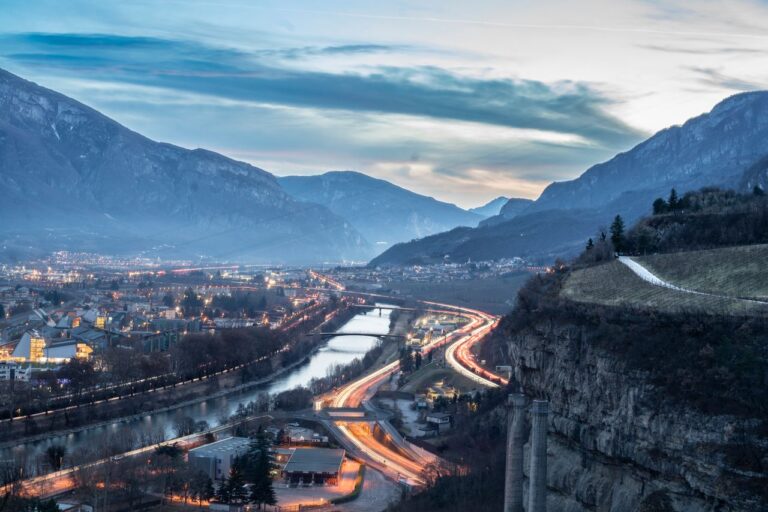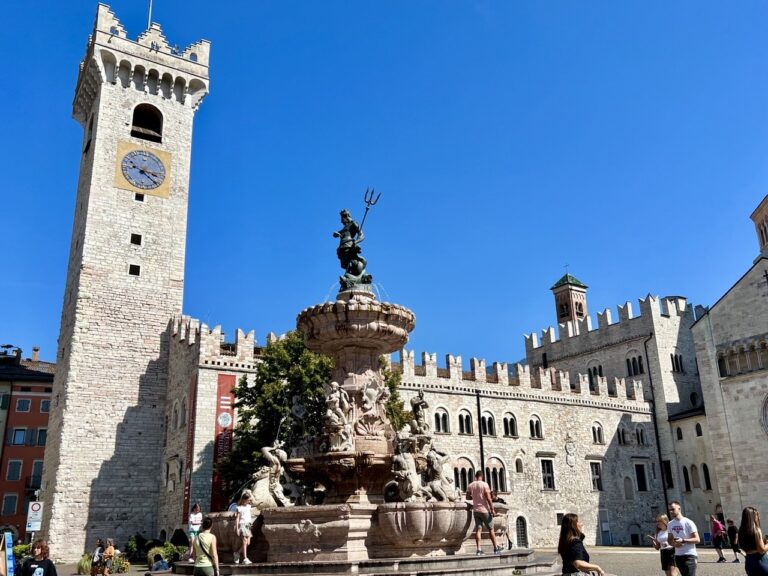

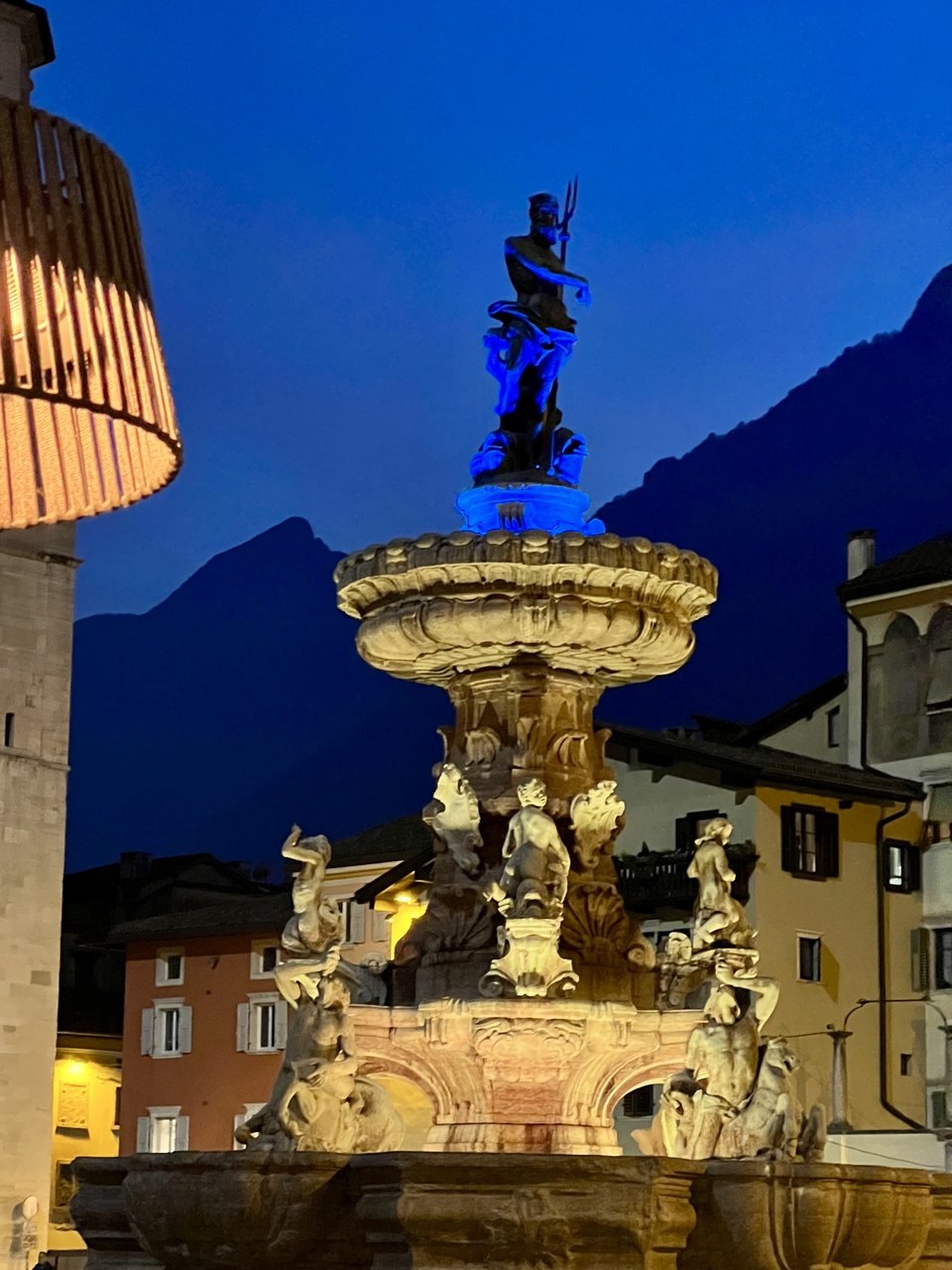
If you have recently moved to Trentino, or you are weighing whether to, you will quickly notice that Trento is not a loud city. It is compact, orderly and surrounded by mountains. But every city has a week where it fully becomes itself. In Trento, that week is the Feste Vigiliane, and it runs from 19 to 26 June 2026. When the week arrives, you will suddenly find people in Renaissance costumes throwing polenta around in the main square, and that is brilliant.
The Feste Vigiliane are Trento’s annual patron saint celebrations, a week-long festival of historical re-enactments, music, food, river races, satirical theatre and fireworks that takes over the entire historic centre every year in the second half of June. They are one of the best ways to understand the city through its history, and we recommend experiencing it at least once.
Who was San Vigilio? And why does Trento celebrate him?
Before we talk about polenta and rafts, let’s quickly summarize the history behind this tradition, simply because the festival makes more sense with it.
San Vigilio (Vigilius of Trent) was a Roman patrician who became the third bishop of Trento around the year 385 AD. He was sent by the bishop of Milan, Saint Ambrose, to Christianise a region that was, at the time, still largely pagan. He studied in Athens, returned to Trento, and was consecrated bishop at a remarkably young age, even by the standards of late antiquity.
He spent the following decades doing missionary work across the Alpine valleys of the Adige, often alone, often meeting resistance. In 405 AD, according to tradition, he was martyred in the Rendena valley after destroying a pagan idol. He is now buried in Trento’s Cathedral, which was built over an earlier church dedicated to him.
His feast day is 26 June. The city has celebrated it for centuries, and since 1984 those celebrations have grown into the full week-long festival that exists today. Trento’s Cathedral, its river, its oldest squares: all of them are connected, one way or another, to the story of this particular bishop.
That is the short version. The longer version involves polenta theft, mock trials and a cage lowered into the Adige river, and we will get to all of that shortly.
When & Where?
Main festival dates: 19–26 June 2026
Opening food tradition (Ganzega): 13 June 2026
Location: Historic centre of Trento: Piazza Duomo, Piazza Fiera, Piazza Santa Maria, the old town streets and the banks of the Adige
Official website: festevigiliane.it
The programme
La Ganzega dei Ciusi e dei Gobj on 13 June 2026
The celebrations begin a week early, on Saturday 13 June, with a large open-air dinner in Piazza Duomo: one of the most beautiful squares in northern Italy is set with long tables, local food, and the full festive atmosphere of the Vigiliane before they have officially started.
The dinner centres on the two symbolic factions at the heart of the festival: the Ciusi (representing Trento) and the Gobj (representing Feltre, a city in Veneto). Their rivalry is theatrical, historical and, it turns out, primarily about polenta.
Places are limited and booking is strongly recommended. Check the official Ganzega page for tickets.
The Corteo Storico & Tribunale di Penitenza on 19 June 2026
The festival officially opens on Friday 19 June with the Corteo Storico: the historical parade that moves through the streets of the old town in Renaissance costume.
The 2026 edition is themed around the Seven Deadly Sins, which is either a very Italian or a very Trentino choice depending on how long you have lived here. Expect flag-wavers, musicians, armour, velvet, and a significant number of people taking photographs.
The parade ends with two symbolic moments: the Alzabandiera (the raising of the flag) and the Giuramento degli Zatterieri (the Oath of the Raftsmen), both of which connect the celebrations to Trento’s history as a city shaped by the Adige river. The raftsmen were the workers who transported timber down the river from the mountains to the plains below, and they were a key part of the city’s economic life for centuries.
Also on 19 June, Piazza Fiera hosts the Tribunale di Penitenza: a satirical public “trial” of local figures and events from the past year.
Think of it as a theatrical roast of the city, presided over by a mock judge, full of local jokes and humour. Some references may be very local indeed if you arrived recently, but the format is for sure universal. Trento makes fun of itself in public, in costume, in front of a large crowd. This is, on reflection, one of the healthier traditions any city can have.
The verdict of the trial determines who will face the Tonca on June 21st. June 19th is probably one of the best days to attend if you are new to the festival.
Magica Notte on 20 June 2026
Saturday 20 June is the Magica Notte: the magic night when the entire historic centre transforms into a large outdoor festival, with music, performances, food and open spaces across Piazza Duomo, Piazza Fiera and beyond.
The city is at its most alive, the streets at their most crowded, the atmosphere at its most festive. Comfortable shoes are recommended. A certain tolerance for queues at the wine stands is also useful.
It is also a very good evening to bring visiting friends or relatives who have been asking “but what is Trento actually like?” Show them Trento during the Magica Notte and they’ll instantly become fans of its charm.
Palio dell’Oca & Tonca on 21 June 2026
On Sunday 21 June, the action moves to the Adige river for the Palio dell’Oca: a raft race on the Adige river between teams representing different districts of Trento, competing in historical costume and completing skill-based challenges along the route.
A quick note for newcomers: yes, Trento is a mountain city. Yes, it also has a traditional raft race on its river. These two facts are entirely compatible and representative of the connection between the city and its river. The Adige has always been central to the Trento’s identity: it connected the city to Venice, to the Po valley, to the rest of Europe. The raftsmen who navigated it were a pillar of the local economy for much of the medieval and early modern period.
After the Palio, comes the Tonca. In all honesty, it is probably one of the things we like more about the festival.
The Tonca is a re-enactment of an old punishment once given to blasphemers in medieval Trento: the condemned person was lowered into the river in a wooden cage, dunked three times, and hauled back out. Today it is entirely theatrical and entirely voluntary, performed with considerable audience enthusiasm on the “convicted” figure from the Tribunale di Penitenza.
Disfida dei Ciusi e dei Gobj on 26 June 2026
The penultimate major event takes place on Friday 26 June in Piazza Fiera.
The Disfida is the annual re-enactment of the old rivalry between Trento and Feltre, centred on the polenta. The Gobj of Feltre defend it; the Ciusi of Trento attempt to take it. The Disfida is colourful, theatrical, loud and genuinely entertaining even if you have no idea what is happening.
Trento and Feltre share a specific chapter of late medieval history: both cities were once allied against the dominance of Venice, a conflict that generated these two symbolic factions: the Ciusi (roughly meaning “the closed ones” or “the isolated ones”) and the Gobj (a term connected to those who accepted Venetian influence). The polenta at the centre of the Disfida is also not random food: it represents the staple of Alpine life and, symbolically, the identity that Trento fought to protect.
Procession, Pan e Vin & Fuochi di San Vigilio on 26 June 2026
On the feast day of San Vigilio, the programme also includes the religious procession and the Pontificale Solenne in the Cathedral, followed by the traditional distribution of Pan e Vin – bread and wine – as a gesture of hospitality and community memory.
At night, the Feste Vigiliane close with fireworks over the Adige. The Fuochi di San Vigilio light up the sky and mountains above Trento on the evening of 26 June and bring the week to an end.
Vigiliane with kids: Piazza Santa Maria, Palazzo Thun and Palazzo Geremia
One of the new features of the 2026 edition is the expanded role of Piazza Santa Maria, which becomes a dedicated space for games, traditional activities, chess and informal social life throughout the week.
Families with children will also find a dedicated programme of workshops, games and activities at Palazzo Thun and Palazzo Geremia. This runs in parallel with the main festival and is especially useful if you want to have fun with younger children without the late nights.
Practical information for newcomers
Most events take place in the historic centre, which is walkable and compact. A few things worth knowing:
- Get there by public transport. The centre fills up quickly, especially on Magica Notte and the 26th. Check Trentino Trasporti for schedules.
- If you come by car, check parking in advance at the Visit Trento parking guide.
- Book the Ganzega early. Places are limited and it fills up.
- Wear comfortable shoes. You will walk further than you expect.
- Check the official programme before you go as times and locations can shift.
- 26 June is a local public holiday. Some offices, shops and services may have different hours. If you have appointments or errands, check in advance.
- Bring people. This is an easy festival to share with visiting friends or family who want to understand what Trentino is actually like.
New to Trentino? That is why you should visit
Moving to a new place is not only about finding work, sorting out a lease and figuring out which office handles your residency registration. It is also about slowly discovering the history, traditions and rhythm of where you are living.
Through Feste Vigiliane you can experience Trento in a different mode: the squares full, the streets loud, the city dressed in its own history. You see local families, students, older residents, volunteers, visitors from other towns and internationals who arrived with two suitcases and are now eating polenta in a medieval square, wondering how they got here.
We know too well how difficult it is to move from outside observers to participants. We reckon if there is a place where that transition can happen smoothly in Trento, the Feste Vigiliane are a good place to let it happen.